
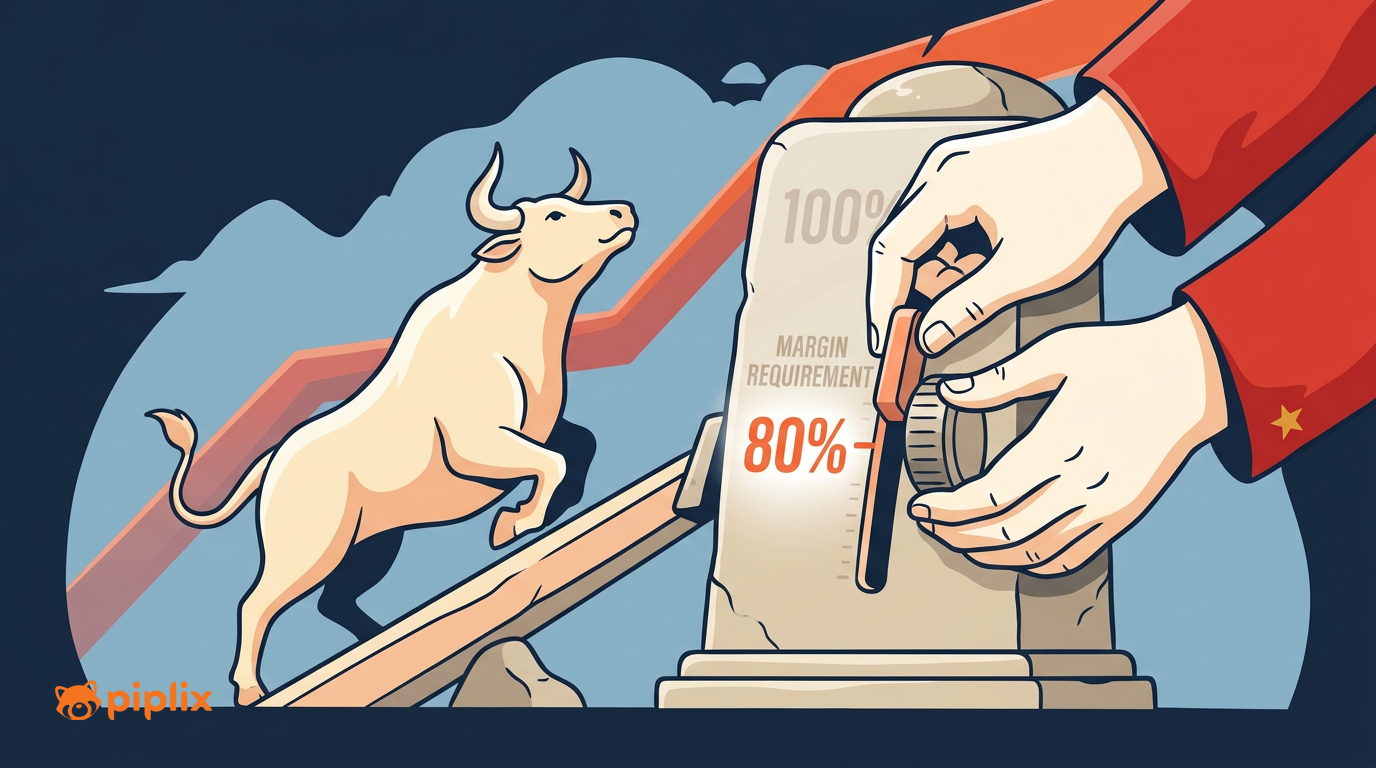

China's Shanghai, Shenzhen and Beijing StockStock refers to an ownership interest in a company, generally represented by shares. The term belongs in Level 7 because it helps connect macro conditions, policy, or another as...Read More exchanges will reduce the minimum Margin RequirementDefinition A margin requirement is the amount or percentage of a position's notional value that must be provided as collateral. Higher margin requirements mean...Read More for leveraged stock purchases from 100% to 80%, effective November 30, 2026. Approved by the China Securities Regulatory CommissionA stated fee charged by some brokers for executing a trade, often alongside a raw spread.Read More, the adjustment is intended to improve MarketA place - physical or digital - where buyers and sellers meet and agree on a price. Lix’s simple rule: no buyers and sellers, no market.Read More LiquidityDefinition Liquidity describes how easily buying and selling can occur without requiring a large change in price. A liquid market generally has active participation, ava...Read More and encourage MarginThe amount your broker sets aside as collateral to open and hold a leveraged position. It is not a fee and it is not your risk limit.Read More-financing activity as Chinese equities face pressure from weak domestic growth and a global technology sell-off. The measure could theoretically generate nearly 400 billion yuan (approximately $59.6 billion) in additional funds. The exchanges also announced fee reductions, while Shenzhen proposed a market-making mechanism for its ChiNext board.
China will lower the minimum margin requirement for leveraged stock purchases from 100% to 80% across the Shanghai, Shenzhen and Beijing stock exchanges, effective November 30, 2026. Approved by the China Securities Regulatory Commission, the measure aims to improve market liquidity and encourage margin-financing activity amid weak domestic growth and a global technology-sector sell-off. The adjustment could theoretically unlock nearly 400 billion yuan (approximately $59.6 billion) in additional funds. Exchanges also announced fee reductions, while Shenzhen proposed a market-making mechanism for its ChiNext board.
