
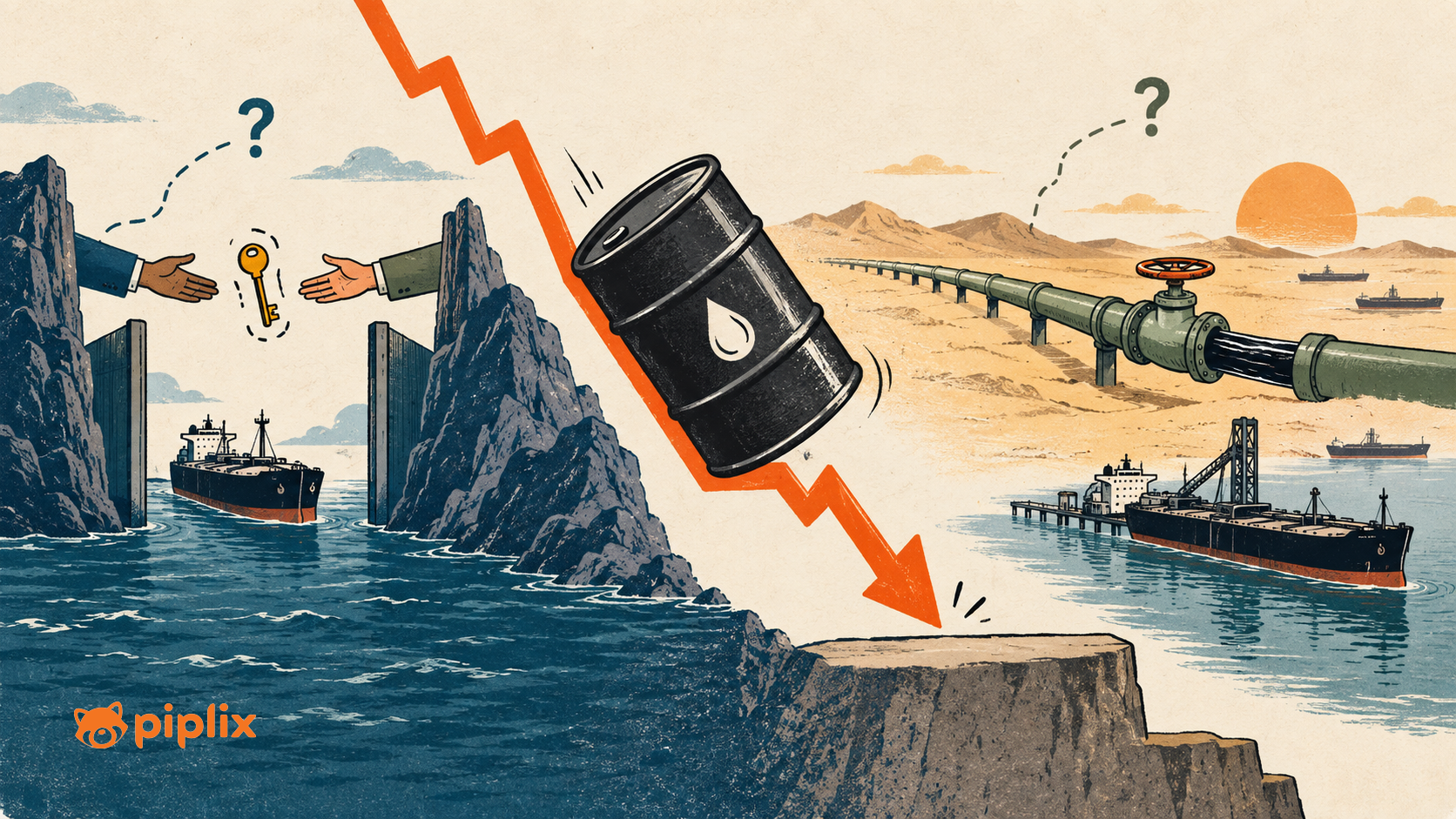

Brent falls to a two-week low below $99 as Iran offers a conditional Hormuz reopening and Saudi Arabia restarts its East-West Pipeline.
OilOil refers to a globally traded energy commodity whose price is shaped by supply, demand, inventories, geopolitics, and economic activity. The term belongs in Level 7 because it...Read More losses deepened as Iran's conditional Hormuz reopening OfferDefinition The offer is another name for the ask: the price at which a seller is willing to sell and at which a buyer can transact. In a two-way quote, the offer is...Read More and Saudi Arabia's East-West Pipeline restart improved the Gulf supply outlook. Brent fell 2% to $98.33 a barrel at 10:27 UTC, while the more active November WTI contract dropped 2.65% to $89.92; both reached their lowest levels since September 8. Reuters reported Saudi Aramco was seeking to raise pipeline flow toward 4 million barrels per day, with a China-bound cargo scheduled to load at Yanbu later Tuesday.
| Item | Value | Why it matters |
|---|---|---|
| F1 | OBSERVED_REACTION | November Brent futures fell $2.01, or 2.0%, to $98.33 per barrel at 10:27 UTC on September 22, extending their decline from 0.89% at 09:32 UTC. |
| F2 | OBSERVED_REACTION | The expiring October WTI contract fell $2.50, or 2.61%, to $93.28 per barrel, while the more actively traded November contract declined $2.45, or 2.65%, to $89.92. |
| F3 | OBSERVED_REACTION | November Brent, October WTI and November WTI futures all touched their lowest levels since September 8. |
| F4 | ATTRIBUTED_INTERPRETATION | A senior Iranian official told Reuters that Iran could reopen the Strait of Hormuz within seven days if the United States eases military pressure and lifts its blockade on Iranian ports; the official said Tehran's UN delegation had authority to revive diplomacy. |
| F5 | CONFIRMED_FACT | Before U.S.-Israeli attacks on Iran began in February, the Strait of Hormuz handled approximately one-fifth of global oil and liquefied-natural-gas supplies. |
| F6 | ATTRIBUTED_INTERPRETATION | Sources told Reuters that Saudi Arabia's restarted East-West Pipeline was operating at a low rate, that Saudi Aramco sought to increase flow toward 4 million barrels per day without a stated timeline, and that one China-bound crude cargo was scheduled to load at Yanbu later on September 22. |
| F7 | ATTRIBUTED_INTERPRETATION | Reuters reported that the pipeline had been used to reroute approximately 4 million barrels per day, around 4% of global oil supply, to Yanbu after disruption to Hormuz flows; traders were also positioning tankers at Port Said and Sidi Kerir for transfers linked to Saudi loadings. |
| F8 | PIPLIX_INFERENCE | The deeper price decline reflects a combined diplomatic and operational easing of immediate supply fears, but the absence of confirmed full pipeline throughput or restored Hormuz traffic means the market is discounting prospective relief rather than completed normalization. |
| F9 | CONDITIONAL_SCENARIO | Confirmed Yanbu loadings, higher Saudi pipeline throughput and restored Hormuz traffic could extend the decline, while failed diplomacy, renewed attacks or persistent refined-product shortages could rebuild the oil risk premium. |
